
USFJ Form 19EJ and SOFA Toll Certificates in Japan
Under Article V, paragraph 2 of the US–Japan Status of Forces Agreement (SOFA), authorized US military vehicles use Japanese toll roads free of charge. For decades the proof was a paper certificate — USFJ Form 19EJ — handed to the toll teller. As Japan moves to ETC-only gates, that paper can no longer be presented, yet USFJI 90-402 still requires full accountability and auditing. Japan Toll Receipts closes that gap.
Reference: USFJ Instruction 90-402 — "Management and Utilization of USFJ Form 19EJ, Certificate for Transit of Toll Roads by Military Vehicles."
At a glance
- Who uses it
- Authorized US military (SOFA) official vehicles
- What form
- USFJ Form 19EJ toll certificate
- Who pays
- Japan's Ministry of Defense — toll-equivalent compensation
- What NEXCO does
- Receives compensation from MOD — it does not write off the toll
- What MOD / Defense Bureau does
- Pays the road operator via regional Defense Bureaus for accepted claims
SOFA Article V, ¶2
US military vehicles operating under the Status of Forces Agreement are permitted to use Japanese toll roads free of toll charges, per the agreement between the Government of Japan (GOJ) and the United States Government (USG).
USFJ Form 19EJ
The "Certificate for Transit of Toll Roads by Military Vehicles." Completed before departure — driver, dispatcher/custodian, and a separate certifying official each fill defined blocks (vehicle type, plate, date, issuing installation, serial number, certifier signature).
USFJI 90-402 mandate
Mandates centralized management, distribution, and—critically—accountability and auditing of toll certificates, including retention of records for 18 months and a Statement of Loss for any missing certificate.
Two versions of USFJ Form 19EJ are in circulation. Older stock is used "until exhausted," after which the 2022 layout applies. Both were designed to be filled in by hand, stamp, or printer — and physically handed to a toll booth attendant.
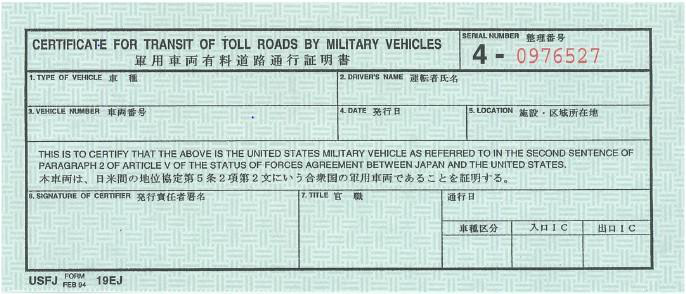
Fields on the 1994 certificate
- Serial number (pre-printed accountability number)
- Type of vehicle (e.g., U.S. Army sedan)
- Driver's name and grade
- License plate number (OVA / USMC number)
- Date of transit
- Issuing installation (e.g., Camp Zama)
- Certifying official signature, grade & unit
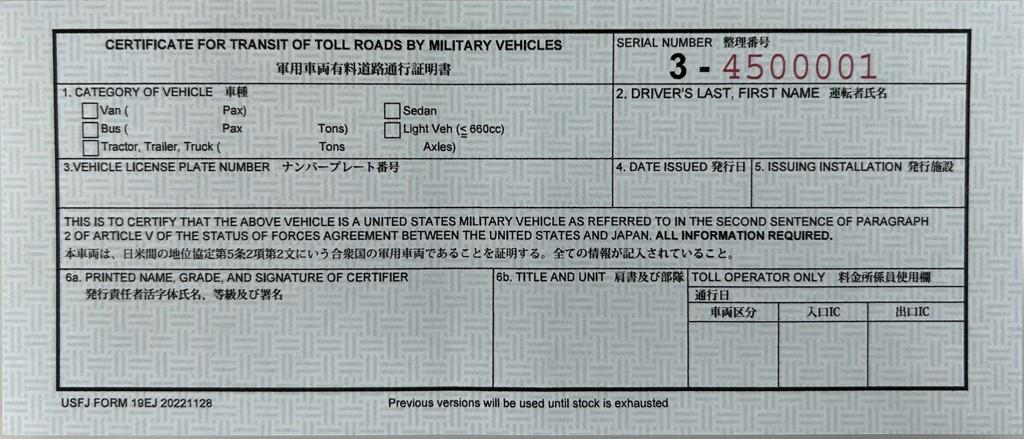
What changed in the 2022 version
- Vehicle category checkboxes (sedan, bus, truck, special)
- TONS and AXLES fields for towing/combination vehicles
- Clearer driver last/first name and plate blocks
- Same certifying-official accountability signature
- Note: driver and certifier may not be the same person
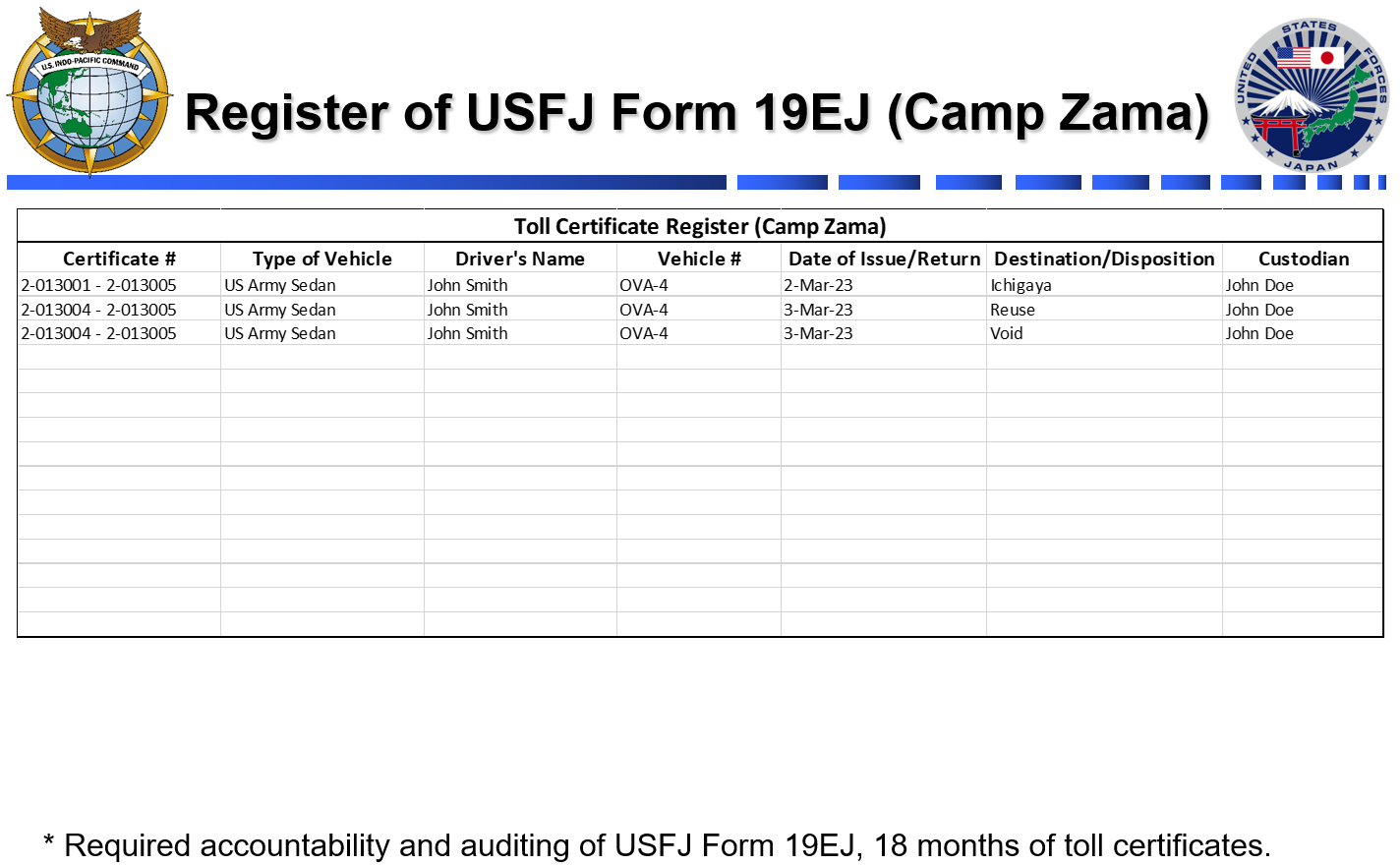
The register enforces accountability
- Serial-numbered issue and return tracking per certificate
- Date issued, recipient, and date returned/used
- Records retained for 18 months for audit
- Statement of Loss required for any missing certificate
Who & what qualifies
- Authorized US Forces personnel, DoD civilians, and SOFA-status members
- US official contractors & eligible employees (MLC / MC / IHA)
- Registered US military / official vehicles only
- Private vehicles are NOT exempt — SOFA covers official use only
Where units obtain Form 19EJ
Form 19EJ toll certificates are not obtained by individuals — they are ordered through the unit supply / dispatch chain. Unit supply officers without certificates on hand request them through their servicing Navy supply activity: historically the Fleet and Industrial Supply Center Yokosuka, Customer Service Department (today NAVSUP Fleet Logistics Center Yokosuka). Drivers issued a temporary loan vehicle by Garrison Mobile Equipment are supplied with passes with the vehicle. For current ordering points of contact, units should confirm with their servicing supply office or installation transportation/dispatch authority.
Reference: Marine Corps Installations Pacific (MCIPAC), “Okinawa Expressway Tolls to Resume” (www.mcipac.marines.mil), which identifies the responsible supply command and ordering channel for the toll certificates. Contact names and numbers in that article may be out of date; verify with your current servicing supply office. Japan Toll Receipts is an independent service and is not affiliated with USFJ, the U.S. Navy/Marine Corps, or DoD.
Per USFJI 90-402 §4.8, the form must be completed before the vehicle departs dispatch — in black or blue ink (stamps or printer are acceptable if legible and aligned, but the certifier signature is always required). Three different people complete defined blocks; the driver and the certifying official may never be the same person.
Who fills which block
- Driver's last name, first name
- Serial-number control
- Type / category of vehicle
- Vehicle number
- Date issued & issuing installation
- Printed name, grade & signature
- Title and unit of the certifier
Field-by-field, with the official examples
Enter the type or check the box, then enter the data: gross weight, number of axles and/or passenger capacity.
e.g. U.S. Army Sedan · U.S. Navy Bus (45 Passenger) · USMC Van (9 Passenger) · AAFES Truck (2-Ton, 5-Ton)
Entered by the driver in Block 2.
e.g. Doe, John
Date the certificate is issued to the driver — any clear format.
e.g. 4 Jul 2023 · Jul 4, 2023 · 7/4/2023
Installation name spelled out; the installation-type acronym is acceptable (AB, NAS, NB, MCAS).
e.g. Camp Zama, Japan · Misawa AB, Japan · Atsugi NAS, Japan
Printed name, grade and signature of the individual authorized to certify. Driver ≠ certifier (deviations require written component-commander approval).
e.g. John Doe, Maj, USA
Position and unit of the certifier.
e.g. Dispatcher, 374 Logistic Readiness Sqdn · Commander, 88th MP Det.
Every USFJ Form 19EJ is controlled by serial number, centrally requisitioned, and printed only by DLA Document Services (Yokosuka). The first digit identifies the service component — which is exactly how each branch is identified and audited (§4.1):
1-0000001 → 1-9999999
2-0000001 → 2-9999999
3-0000001 → 3-9999999
4-0000001 → 4-9999999
Components (5 AF, USARJ, CNFJ/CNRJ, MARFOR-J) appoint a Program Manager and alternate, requisition/fund printing, and validate questionable certificates to USFJ quarterly. Program Managers and certifiers attend training before appointment and every two years thereafter.
Every unit maintains a register (§4.5)
- Certificate serial number
- Type of vehicle
- Driver's name
- Vehicle number
- Date of issue / return
- Destination of vehicle
- Certifying official / custodian / dispatcher
- Issuing installation in the register title
Accountability rules (§2.2.3, §4.7)
- Document the previous 18 months of certificate disbursement
- Unused certificates returned and annotated "VOID" / "Returned", verified before shredding or reuse
- Lost certificate → Statement of Loss memo (date, serial number, location, details)
- Questionable certificates validated to USFJ quarterly
A driver presented the paper certificate at a staffed toll lane. The teller accepted it, the vehicle passed toll-free, and the unit retained copies for audit. This depended on a human at the booth and a physical document.
Japan is converting to ETC-only gates with no staffed lanes to hand a certificate to. Toll-free entitlement moves onto government-issued ETC cards — but the moment tolls go electronic, the unit loses the paper audit trail that USFJI 90-402 requires. There is no booth, no signature, no retained copy.
The accountability gap: Dozens or hundreds of ETC cards get issued across installations, but no one has a per-card, per-vehicle, per-trip record showing who drove where, when, and whether the vehicle was authorized. Misuse — a card used on a personal vehicle on a weekend — becomes invisible until it is too late.
Turn government ETC cards into a review-organized accountability system.
Per-card, per-trip records
Every government ETC card generates a structured PDF + CSV record of each trip — date, entry/exit IC, vehicle, and toll — automatically by email on a daily, weekly, or monthly schedule. The audit trail rebuilds itself electronically.
Authorized-vehicle monitoring
Register an registered vehicle list per card. Activity from a vehicle that is not on the list is surfaced as a next-day needs-review flag — exactly the oversight the paper certifier signature used to provide.
Unauthorized-use detection
Spot the patterns that matter: a card used off-base on a weekend, on a route inconsistent with mission use, or on a personal vehicle. Trends are visible the next day — not at month-end billing.
18-month retention support
USFJI 90-402 requires 18 months of toll-certificate accountability. JTR delivers durable PDF + CSV evidence to your inbox on every cycle, so records exist outside the 15-month MEISAI window.
Program-level oversight
Roll up many cards and installations under one management view — the modern equivalent of the Form 19EJ register, but live, searchable, and consolidated across the program.
Built for the ETC transition
As staffed lanes disappear, JTR is the accountability layer that lets the toll-free entitlement continue cleanly — without paper, without a booth, and without losing oversight.
Need organized ETC records for official vehicles?
Japan Toll Receipts turns ETC usage into clean PDF & CSV reports for review, reconciliation, and usage review support.
Why next-day authorized-vehicle review matters for command compliance
6. Toll Road Certificates. Operators of GOV will use USFJ Form 19EJ (Certificate for transit of toll roads by military vehicles) to pay road tolls. The certificates may not be used at any time by operators of POV. Drivers (military or civilian) misusing the certificates will be disciplined. The certificates will be completely filled out before vehicles are dispatched, and will be kept in a readily available location for immediate presentation and to toll booth employees.
Plain-language summary: government vehicles (GOV) use Form 19EJ; privately owned vehicles (POV) may never use it, and any driver — military or civilian — who misuses a certificate is subject to discipline.
Section 6 states the rule clearly — but on ETC-only roads there is no longer a toll-booth attendant to check, at the moment of travel, whether the vehicle is a GOV and whether it is authorized. The control point that used to live at the booth disappears. Japan Toll Receipts restores that control point after the fact: when a government ETC card is used by a vehicle that is not on the command’s registered-vehicle list, the activity is surfaced the very next day as a ‘review recommended’ flag for the designated branch managers and command leaders.
The result is awareness in near-real time instead of months of silence: possible unrecognized vehicle usage — for example a certificate-linked card used on what may be a POV on a weekend — is reviewed within a day, giving command an immediate, fact-based starting point to verify, document, and enforce policy before a pattern compounds. This shortens the window in which undetected misuse can continue and supports an immediate command action plan.
Japan Toll Receipts is an independent commercial service and is not affiliated with, endorsed by, or acting on behalf of USFJ, USFJ Yokosuka, the U.S. Navy, the U.S. Department of Defense, NEXCO, or the ETC利用照会サービス (MEISAI). It surfaces toll records and next-day review flags for authorized command review only; it does not determine, allege, or adjudicate misuse, and any disciplinary determination remains solely with the responsible command.
Need organized ETC records for official vehicles?
Japan Toll Receipts turns ETC usage into clean PDF & CSV reports for review, reconciliation, and usage review support.
SOFA toll-free travel is one slice of a much larger government picture. Japan itself exempts certain official and emergency vehicles from expressway tolls — and the same accountability and ETC-transition challenges apply across every public fleet.
The legal basis (道路整備特別措置法)
Under the Act on Special Measures concerning Road Construction, emergency vehicles (緊急自動車) on duty are outside the scope of expressway and toll-road charges. Categories are defined in the Road Traffic Act Enforcement Order.
Who qualifies
Fire engines (消防車), ambulances (救急車), and police cars (パトカー), plus — by MLIT notice — certain disaster-relief, flood-control, and firefighting vehicles even when not classified as 緊急自動車.
The ETC catch
Exemption depends on the mission and the road operator. Crucially, passing through an ETC lane can still charge the normal toll — so even an exempt vehicle needs the right procedure, and a record to prove the trip qualified.
Even within Japan's own emergency-vehicle rules, treatment has been inconsistent — ambulance return trips, for example, were long handled differently by region and road company before a move toward round-trip exemption. That is the same lesson: an entitlement without a per-trip, per-vehicle record is hard to administer. Whether it is USFJ official vehicles or a municipal fire department, Japan Toll Receipts provides the ETC accountability layer that makes a toll-free program auditable.
Redeemed by the Ministry of Defense for US military toll passes in 2008 (Board of Audit of Japan).
Reported as the annual amount the Japanese government pays in highway tolls for US military-related use under SOFA (2019 report).
Share of all Japanese tolls paid via ETC — underscoring why an ETC-only future is inevitable for military travel too.
The toll-free arrangement traces to Article V of the US–Japan SOFA, which grants US forces access to Japanese roads, ports and airfields "free from toll and other charges" for official movements. In 2008–2009, the Board of Audit of Japan publicly questioned how the entitlement was applied — noting that a base agency had advertised toll passes with all car rentals, and that the certificates carried no information about the purpose of each trip. The audit pressed the Ministry of Defense and USFJ to clarify what counts as "official purposes."
That 15-year-old debate is exactly the problem JTR is built for: the entitlement is legitimate, but without a per-trip, per-vehicle record there is no way to demonstrate that travel was official. ETC makes every trip electronic — and with the right reporting layer, every trip becomes auditable. What the Board of Audit said was missing in 2009 (purpose, accountability, a paper trail) is precisely what an ETC accountability system can now supply automatically.
Important: USFJ Form 19EJ applies only to official, government-paid travel in authorized government vehicles (GOV). It is not a personal benefit and cannot be used for a privately owned vehicle (POV).
Want a personal ETC card? (SOFA / military / MOFA members)
If a SOFA-status member, U.S. military member, or MOFA-affiliated person wants an ETC card for their own personal vehicle, that is separate from the Form 19EJ official-travel system. Personal ETC cards for SOFA and international residents are available through japanetccard.com — designed to help SOFA-status and foreign residents obtain an ETC card without the usual Japanese-language application and bank-account hurdles.
japanetccard.com is a separate service for personal ETC cards. Personal toll charges on a personal ETC card are the individual’s own responsibility and are not covered by the SOFA official-travel toll exemption or Form 19EJ.
Who actually pays? Japan-side, it is the Ministry of Defense
Japan does not simply let the expressway company absorb the loss. Because tolls cannot be collected from US Forces Japan military vehicles, Japan's Ministry of Defense compensates the toll-road operators through a loss-compensation process run by the regional Defense Bureaus. The budget sits in the General Account under Defense Ministry Headquarters, item "Defense Facilities Stable Operation Related Expenses." In FY2008 the Board of Audit identified ¥862,030,000 in such compensation.
| Step | Responsible party |
|---|---|
| Official US vehicle mission | US military unit / component |
| Form 19EJ issuance & control | USFJ / component / installation program managers |
| Certificate submitted at toll booth | Driver / unit |
| Toll-loss claim prepared (quarterly) | Toll-road operator (e.g. NEXCO) |
| Claim review, contract & payment | Ministry of Defense regional Defense Bureau |
| Budget source | Japan General Account — Defense Ministry HQ |
What the audit flagged: The Board of Audit found weaknesses in the old paper system — questionable use involving rental cars, weekend/holiday use, missing vehicle information, and certificates accepted as valid military use without sufficient verification. It required stronger checking of each certificate's "official purpose" and closer coordination with USFJ on questionable cases. A per-trip, per-vehicle ETC record answers every one of those findings.
The precise term: 有料道路損失補償 (toll-road loss compensation)
NEXCO or another toll-road operator does not collect the toll from the US military vehicle at the gate. The operator later submits the military toll certificates and claim documents to the appropriate regional Defense Bureau (地方防衛局). The Ministry of Defense reviews the claim and pays the toll-equivalent amount as 有料道路損失補償 — toll-road loss compensation. It compensates the operator, NOT the driver, and not the US military directly. So NEXCO does not simply "write it off": for accepted claims, the operator recovers the toll-equivalent amount through the MoD process.
Two levels inside the Ministry of Defense
- Budget / policy: Defense Ministry Headquarters provides the budget and policy basis (General Account, item "Defense Facilities Stable Operation Related Expenses").
- Execution / payment: Regional Defense Bureaus (地方防衛局等) receive claims, inspect certificates, decide the amount, sign the compensation contract, and pay the operator.
FY2008 — the clean official figure
- ¥862,030,000+ in toll-road loss compensation
- 970,462 vehicle passages
- 49 road operators · 180 compensation contracts
- Processed across 9 regional Defense Bureau offices (Hokkaido, Tohoku, North Kanto, South Kanto, Kinki-Chubu, Chugoku-Shikoku, Kyushu, Okinawa + Tokai branch).
What it has cost over time
| Period | Amount | Source type |
|---|---|---|
| FY2008 | ¥862,030,000+ (970,462 passages) | Board of Audit (official) |
| 2018 | ~¥701M (~664,000 passages) | News report (Mainichi) |
| 2009–2018 total | ~¥7.339 billion | News report (Mainichi) |
| Later years | MoD review-sheet line items (e.g. ¥167M, ¥339M) | MoD review sheets (line items, not totals) |
Research note: The latest clean official total in public audit records is FY2008 (¥862M+). Later public reporting placed 2018 at ~¥701M and the 2009–2018 total at ~¥7.339B. MoD administrative review sheets continue to show toll-road loss-compensation entries in later years, but those are line items, not full annual totals. A single official current-year figure (FY2023–2025) should not be stated unless confirmed from full MoD budget, review-sheet, or disclosure records.
Official & public sources
- Board of Audit of Japan — toll-road loss compensation for US military passes (FY2008, ¥862M+)
- House of Councillors — Cabinet answer on US military expressway use & 有料道路損失補償
- Mainichi (2020) — ~¥7.339B over 10 years (2009–2018); 2018 ≈ ¥701M (news report)
- USFJ Instruction 90-402 — Management & Utilization of USFJ Form 19EJ (usfj.mil, PDF)
- Stars and Stripes — "Japan to discuss free toll passes" (Oct 28, 2009)
- Stars and Stripes — "US military defends use of highway toll tickets in Japan" (2008)
- Marines.mil — "Electronic Toll Collection open to SOFA personnel"
- Emergency vehicles (緊急自動車) & toll exemption — overview
- Honshi expressway — emergency / disaster vehicle toll handling
- Fire & Disaster Management Agency — emergency-vehicle toll exemption (PDF)
Paper certificates are ending. ETC alone is not the answer.
Paper stops being accepted
As Japan removes staffed toll lanes, there is no attendant to hand a USFJ Form 19EJ to. The 1994 and 2022 certificates simply cannot be presented at an ETC-only gate.
Vehicles must be equipped & verified
Government fleets will need ETC on-board units installed and each card correctly registered and verified to the NEXCO / MEISAI network — a real onboarding effort across every installation and vehicle.
The accountability gap remains
Even fully equipped, ETC only produces a billing feed — not the per-trip, per-vehicle, purpose-aware audit trail USFJI 90-402 requires. That gap is exactly what Japan Toll Receipts fills.
Bottom line: The switch to ETC solves payment, not accountability. The program still needs to prove every trip was official, tie it to an registered vehicle, and retain the record for 18 months. Japan Toll Receipts is the layer that turns the ETC billing feed back into a defensible toll-certificate program organized for review.
USFJ Form 19EJ & SOFA tolls — FAQ
What is USFJ Form 19EJ?
USFJ Form 19EJ is the "Certificate for Transit of Toll Roads by Military Vehicles" — the paper certificate historically presented for qualifying U.S. Forces official vehicle travel on Japanese toll roads. Its management is governed by USFJ Instruction 90-402.
Does NEXCO get paid for U.S. military toll travel?
Public sources indicate road operators may recover accepted claims through Japan’s Ministry of Defense toll-road loss-compensation process, rather than the amount simply being written off.
What is 有料道路損失補償?
It is the Ministry of Defense toll-road loss-compensation process. The ministry compensates the road operator for toll amounts not collected from qualifying official U.S. Forces vehicle travel.
Does the U.S. military pay the toll directly?
Based on public sources, the toll-equivalent amount is handled through Japan’s Ministry of Defense loss-compensation process to the operator — not paid by the driver at the gate, and not billed directly to the U.S. military.
Is SOFA toll travel the same as Japanese emergency vehicle toll exemption?
No. SOFA-related travel follows the Status of Forces Agreement and a Ministry of Defense compensation process, while Japanese police, fire, and emergency vehicles follow separate non-collection rules under Japanese notices. They are different systems.